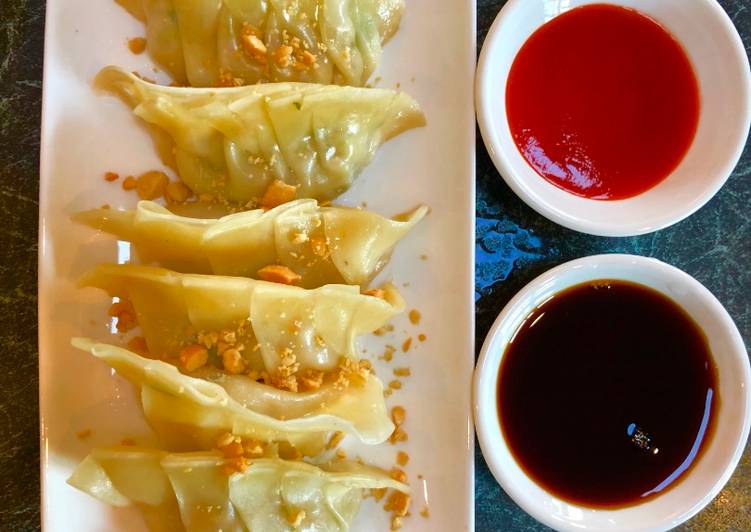
Hey everyone, hope you’re having an incredible day today. Today, I’m gonna show you how to prepare a special dish, gyoza (japanese dumplings). One of my favorites. For mine, I’m gonna make it a little bit tasty. This will be really delicious.
Here's my mother's recipe for making homemade gyoza. Try it out and see if you agree with me that these are the best you've tasted! As far as dumplings go, Japanese-style gyoza are some of the simplest to make, if only for the fact Dumpling-making goes faster when there are friends involved.
Gyoza (Japanese Dumplings) is one of the most popular of recent trending foods in the world. It’s appreciated by millions every day. It’s simple, it’s fast, it tastes delicious. They are nice and they look wonderful. Gyoza (Japanese Dumplings) is something that I have loved my entire life.
To begin with this particular recipe, we have to first prepare a few components. You can have gyoza (japanese dumplings) using 11 ingredients and 13 steps. Here is how you can achieve it.
The ingredients needed to make Gyoza (Japanese Dumplings):
- Make ready 32 Dumpling wrappers
- Get 2 cloves Garlic
- Get 1/3 Chinese cabbage
- Take 1 handful chopped spring onions or scallions
- Make ready 1 teaspoon Salt and pepper
- Prepare 1 teaspoon Cayenne chilli powder
- Prepare 1 teaspoon Cumin powder
- Take 1 handful chopped Fresh coriander
- Take Sesame oil
- Get 300 grams Peeled and deveined prawns/shrimp
- Take Dipping sauces of choice
Japanese gyoza dumplings are super easy to make at home. Plus, they taste better than anything you could buy out on the street or frozen from a store, since you can make use of the freshest high quality. Gyoza is a type of Japanese dumplings, with juicy meat filling inside of dumpling wrappers. Originating from Chinese jiaozi dumplings, they have become a mainstay of Japanese recipes.
Instructions to make Gyoza (Japanese Dumplings):
- If you have bought frozen dumpling wrappers make sure you remember to thaw them out / defrost them ahead of time.
- Shred your cabbage and onions in a blender.
- Take your prawns and squeeze as much of the moisture out as possible with some paper towels. Then shred them in a blender.
- Add the shredded ingredients to a large bowl.
- Finely chop and add the coriander.
- Finely chopped and add garlic. Also add your seasoning and spices.
- Add some seasame oil, enough so that you can mix the filling together into a paste.
- Take a single dumpling wrapper and put a heaped teaspoon in the middle.
- Wet your finger in the water and dampen the exposed bottom half of the wrapper.
- Fold the wrapper in two and pleat across, making sure you apply enough pressure so that the edges stick.
- When you have finished preparing the dumplings, heat some sesame oil in a pan. Then fry until the bottom of each dumpling is golden brown.
- Add 1/2 cup of water to the pan and cover. Leave until all the water has evaporated. The dumpling should look nice and moist - if they are still a little on the hard/dry side just add a bit more water.
- I like to serve them with soy sauce, chilli sauce and some crumbled roasted peanuts.
Gyoza are dumplings stuffed with a savory filling of ground meat and veggies. Japanese gyoza tend to be made with a thinner wrapper and stuffed with a finer filling than Chinese potstickers. Jiaozi (Chinese: 餃子; [tɕjàu.tsɨ] (listen)) are a kind of Chinese dumpling, commonly eaten in China and other parts of East Asia. They are one of the major dishes eaten during the Chinese New Year and. Japanese gyoza is very similar to Chinese potstickers.
So that is going to wrap this up for this special food gyoza (japanese dumplings) recipe. Thank you very much for reading. I am sure you will make this at home. There is gonna be interesting food at home recipes coming up. Don’t forget to save this page on your browser, and share it to your family, friends and colleague. Thanks again for reading. Go on get cooking!